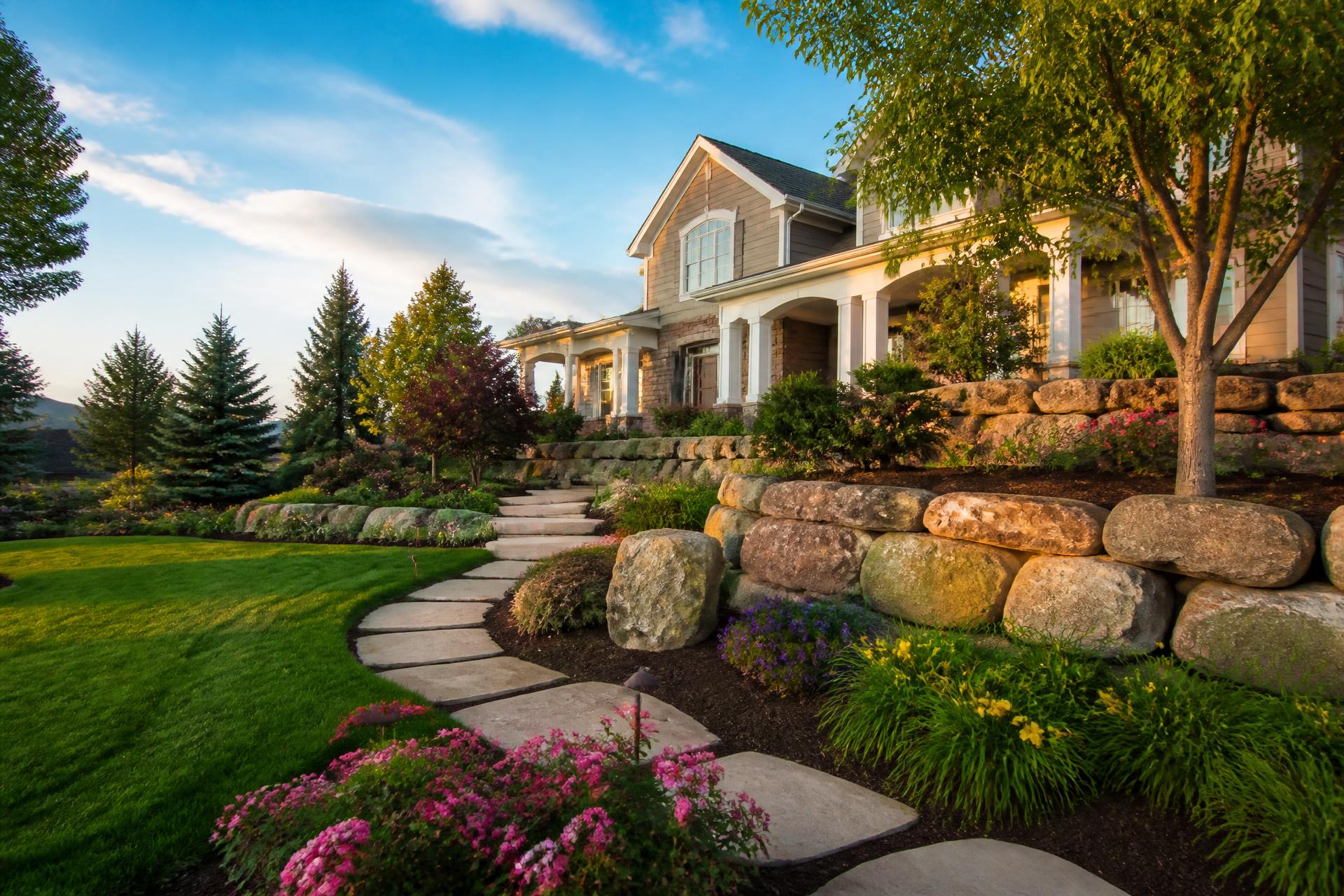
A practical comparison of rock and mulch for Butte County yards — cost, water use, fire exposure, and maintenance over time.
This is one of the most common questions we get on a site walk, and the honest answer is that neither material is universally better — each one solves a different set of problems, and most well-designed Butte County properties end up using both in different zones rather than picking one for the whole yard.
The decision matters more here than it might in a milder climate, because our conditions push harder on both materials: long, hot, rainless summers that bake mulch and test rock's heat reflection, heavy winter runoff that can wash lighter material downhill, and real fire exposure across the Ridge and foothill communities that makes what's touching your house a genuine safety consideration, not just an aesthetic one.
What mulch does well
Bark and shredded mulch remain one of the best tools for actual soil and plant health. A properly maintained mulch layer moderates soil temperature, slows moisture evaporation through the dry season, suppresses weed germination, and breaks down over time to add organic matter back into the soil — something rock simply can't do.
In beds with a lot of shrubs, perennials, and seasonal color — especially where soil quality matters for what's growing — mulch is usually the better long-term choice. It also has a softer, warmer visual character that reads well around cottage-style or heavily planted beds.
What mulch struggles with here
Mulch has three real weaknesses in our climate. First, it breaks down and needs replacing, typically once a year for most Butte County properties, more often in beds that get full summer sun and heavy irrigation. Second, on any real slope, mulch migrates downhill during heavy winter rain, ending up on paths and patios instead of in the bed. Third, and most importantly for foothill and Ridge properties, bark mulch is combustible, and dry mulch sitting directly against a structure is specifically the kind of material that carries fire risk assessments flag in Zone 0.
What decorative rock does well
Rock — whether crushed granite, river cobble, or larger accent boulders — doesn't break down, doesn't need annual replacement, and dramatically cuts water use in the beds where it's installed since there's no organic material competing for or losing moisture. It also holds its position on slopes far better than mulch when it's properly based and bordered, and it doesn't carry the same fire risk that bark mulch does near a structure.
For low-water, low-maintenance zones — pathways, xeriscape beds, areas around a fire pit or patio, and especially anything within the first several feet of a house — rock is generally the stronger choice in this climate.
Where rock falls short
Rock does nothing for soil health and can actually work against it — a rock bed over unamended soil stays exactly as poor as it started, and rock absorbs and re-radiates heat, which can stress heat-sensitive plants growing directly in it during a valley summer. It's also more expensive and labor-intensive to install correctly, since it needs a prepared base and borders to avoid sinking into the dirt or migrating outside the bed. And swapping rock out later, if you change your mind about the design, is a much bigger job than pulling out and replacing mulch.
Fire exposure: the factor generic advice skips
Because so much of Butte County sits in or near wildland-urban interface areas — Paradise, Magalia all included — the fire-risk difference between rock and mulch is a genuinely practical factor, not a minor consideration.
The first five feet around a structure (often called Zone 0) is where this matters most. Combustible mulch piled against siding or under windows gives fire an easy path to the house. Rock, gravel, or bare mineral soil in that same zone removes that fuel path entirely. Further from the structure, mulch becomes a reasonable option again, but we generally recommend rock, gravel, or hardscape for anything touching the foundation on a Ridge or foothill property.
Cost comparison over time
Mulch is cheaper per yard up front but recurring — most properties are back to buying and installing more mulch every year to eighteen months, which adds up over a five- or ten-year horizon. Rock costs more to install initially, largely due to base prep and delivery, but functions essentially as a one-time cost with no annual replacement, aside from an occasional topping-off in high-traffic areas.
For a property owner planning to stay put for several years, rock's higher upfront cost is frequently offset by the eliminated annual mulch expense. For a property being prepped for a quick resale, mulch's lower upfront cost and immediate visual freshness can make more sense.
Water use and drainage differences
Mulch helps retain soil moisture, which can reduce watering frequency for the plants growing in it — useful in beds with moisture-loving plants. Rock does the opposite: it sheds water rather than holding it, which is exactly what you want in a drought-tolerant, low-water planting zone, but not ideal for a bed full of thirstier ornamentals.
On sloped ground, particularly common on Ridge properties, both materials need attention to drainage design. Mulch on a slope benefits from check structures or terracing to keep it in place through winter storms. Rock on a slope needs a compacted base and border edging, or it will shift and expose bare soil to erosion during a heavy runoff event.
A practical zone-by-zone approach
Rather than choosing one material for the entire property, most of the yards we build use both, matched to what each zone needs.
- Within 5 feet of the house: rock, gravel, or hardscape — no bark mulch touching the structure
- Planted beds further from the house with shrubs and perennials: mulch, for the soil and moisture benefits
- Paths, driveways, and low-maintenance accent areas: rock or decomposed granite
- Slopes and drainage-heavy areas: rock with a proper base, or mulch only where check structures keep it in place
- Xeriscape or drought-tolerant zones further from the house: rock, to match the low-water planting palette
Making the call for your property
The right mix depends on where your property sits, how it's planted, and what its fire exposure looks like. A Chico valley yard with a shaded, heavily planted backyard has a different answer than a Magalia lot backing up to timber, or an Oroville property surrounded by open ground. We walk the property, look at slope, sun exposure, existing planting, and proximity to structures before recommending a material mix — it's rarely a single answer for the whole yard.
Frequently asked questions
Rock, gravel, or bare mineral soil is the safer choice within the first five feet of a structure. Bark mulch is combustible and shouldn't be placed directly against siding in fire-prone areas.
Related services & areas
Keep reading
- Common Landscaping Mistakes That Cost Property Owners Money
The recurring landscaping mistakes we see on Butte County properties — and why they end up costing far more to fix than to avoid.
- Landscape Design Ideas for Butte County
Design approaches that actually hold up to Butte County heat, clay and granite soils, deer, and winter runoff — not generic curb-appeal advice.
- How to Choose the Right Landscaping Contractor
What to actually ask before hiring a landscaping or lot clearing contractor in Butte County, and the red flags worth walking away from.
Want this handled on your property?
Send photos and a few details and we’ll get you a written estimate — Paradise, Magalia, Chico, Oroville, and throughout Butte County.