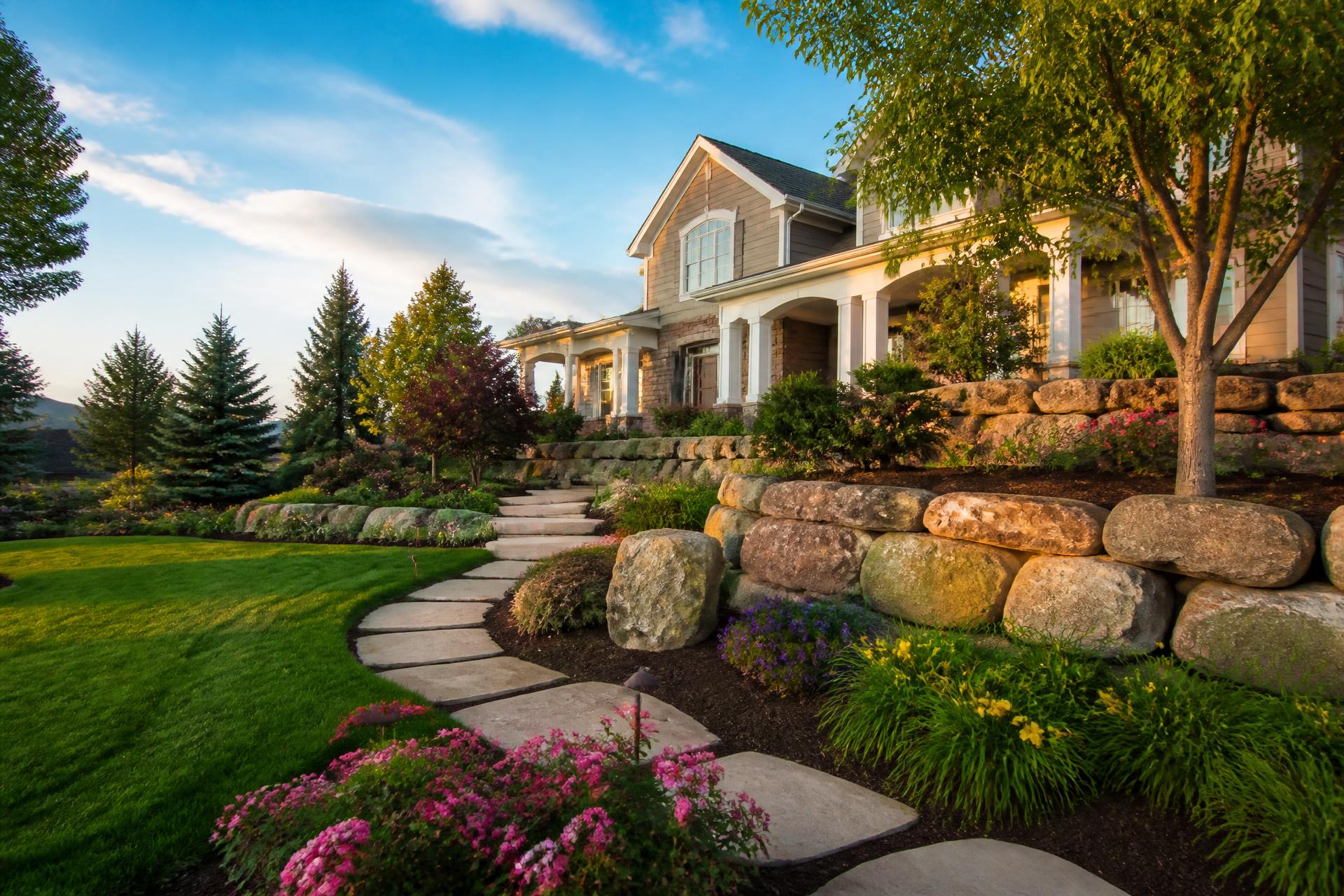
Design approaches that actually hold up to Butte County heat, clay and granite soils, deer, and winter runoff — not generic curb-appeal advice.
A lot of landscape design advice online is written for climates that don't have much in common with Butte County. Advice built around mild, even-rainfall regions doesn't account for what a Chico July does to a new planting bed, what deer pressure does to a shrub selection in Magalia, or what a heavy winter runoff event does to a foothill slope above Oroville. Good design here starts by designing around the conditions, not against them.
The properties we work on span a real range — Ridge lots in Paradise and Magalia with decomposed granite and tight, treed footprints; valley yards in Chico on heavier clay with full summer sun exposure; and larger acreage in Oroville where design has to account for slope, wildlife, and fire exposure all at once. The ideas below are grouped by the conditions they actually solve.
Start with the water, not the plants
Before any planting plan, we look at how water moves across the property in a real winter storm, not a dry-season site visit. Butte County rainfall is concentrated and often intense, arriving as atmospheric river events rather than steady rain. A yard that looks flat and unremarkable in August can be a runoff corridor in February.
Design elements that use this water productively, rather than fighting it, tend to perform better and cost less to maintain long-term.
- Dry creek beds that route roof and hardscape runoff to a planted low point instead of a storm drain
- Rain gardens or slightly depressed planting beds positioned where water naturally collects
- Permeable paths and patios (decomposed granite, gravel, or permeable pavers) that let water infiltrate instead of sheeting off
- Swales cut along the high side of a sloped yard to intercept water before it reaches the house or a lower planting bed
Design around the soil you actually have
Ridge properties in Paradise, Magalia commonly sit on decomposed granite — soil that drains fast, doesn't hold nutrients well, and can be loose on slopes. Valley properties around Chico tend toward denser clay that holds water, compacts easily, and cracks when it dries out. Neither soil type is a problem once the design accounts for it; both become a problem when the plan assumes generic 'good garden soil.'
On decomposed granite, we typically amend planting beds generously and lean on plants that tolerate lean, fast-draining soil rather than fighting to hold moisture. On clay, we focus on breaking up compaction before planting and building beds slightly raised or mounded so roots aren't sitting in saturated soil after a storm.
Plant selection built for Butte County heat
Summers here regularly push past 100 degrees in the valley and stay hot on the Ridge, with long stretches of no rain from roughly May through October. Plants selected for a nursery display in spring often struggle by their second August unless they were chosen with that dry heat in mind from the start.
We lean toward Mediterranean and California-native plant palettes for exactly this reason — species that evolved for, or adapted to, a wet-winter, dry-summer pattern rather than plants that expect moisture year-round. Once established, these plants typically need far less supplemental water than lawn-and-annual-heavy designs, which matters both for the water bill and for how the landscape looks during a heat wave.
Designing around deer pressure
Deer pressure is a real design constraint across most of Butte County's foothill and Ridge communities, and it's one that generic landscape advice almost never addresses. A planting plan that looks great on paper can be stripped to stems within a season in Magalia if deer-resistant selection wasn't part of the design from day one.
Deer-resistant doesn't mean deer-proof — a hungry enough deer in a dry year will sample almost anything — but building a planting palette weighted toward naturally less-palatable species dramatically cuts the damage and the replacement cost.
- Lean on aromatic and textured foliage — lavender, rosemary, sage, and similar Mediterranean herbs are consistently lower on the deer menu
- Ornamental grasses tend to get browsed less than broadleaf perennials
- Reserve the most deer-favored plants (roses, hostas, many fruit trees) for spaces closer to the house or behind fencing
- Group vulnerable new plantings together near the house for the first season or two, when they're most tender, rather than scattering them across open ground
Fire-aware design without giving up a landscape
Design and defensible space aren't opposing goals — the properties that look best years down the line are usually the ones where fire awareness was baked into the layout from the start, not bolted on afterward as a separate clearing job.
That means keeping the area within the first five feet of the structure free of dense, continuous shrub cover and combustible mulch, spacing plantings so fire can't move easily from one shrub to the next, and choosing lower-fuel groundcovers like rock or well-irrigated low plantings close to the house. Further from the structure, there's more room for fuller planting, but the spacing principle still holds — clumps and breaks rather than one continuous hedge line.
Hardscape choices for the local climate
Decorative rock and gravel do real design work here beyond looking tidy — they cut irrigation needs, resist the freeze-thaw and expansion cycles of our clay soils better than some paving options, and don't fuel a fire the way bark mulch can close to a structure. Crushed granite paths in particular read as a natural extension of the Ridge's own geology rather than an imported material.
Boulders and larger accent stone are worth considering for foothill and acreage properties specifically because they're already part of the local landscape character — a boulder grouping in Oroville looks like it belongs, in a way that a formal paver pattern sometimes doesn't.
Zoning the yard by use and water need
One of the most useful design shifts we make on Butte County properties is grouping plants by water need rather than by appearance alone — sometimes called hydrozoning. A small, higher-water zone near the house for a compact lawn area or a few thirstier ornamentals, surrounded by a much larger low-water zone of natives and Mediterranean plants further out, uses water efficiently and simplifies the irrigation design considerably.
This also naturally supports fire-aware design, since the higher-water, more irrigated zone tends to sit closest to the structure where defensible space matters most, while the drought-tolerant zone further out needs less water precisely where less water is available to fight a fire anyway.
Seasonal color that survives the whole year
Seasonal color is worth having, but it works best treated as an accent rather than the backbone of the design. A planting scheme built entirely around spring annuals looks tired by July and bare by November. We typically anchor beds with structural shrubs and grasses that hold their shape year-round, then use a smaller number of seasonal color pockets near entries and other high-visibility spots where the extra water and replanting effort pays off visually.
Putting it together on different property types
On a Paradise or Magalia rebuild lot, a strong design usually means a tight, fire-aware planting zone close to the house, decomposed granite or rock paths that survive the soil type, and a drainage plan that gets the pad's runoff away from the foundation before anything else is decided. On a Chico valley lot, the priorities shift toward heat-tolerant planting, efficient drip irrigation, and hardscape that gives usable outdoor living space without a high-maintenance lawn baking in August sun. On larger Oroville acreage, design is often about zones — a more finished, irrigated area close to the house, transitioning to lower-maintenance native plantings and open, fire-conscious spacing further out.
Frequently asked questions
Mediterranean herbs like lavender, rosemary, and sage, along with California natives such as manzanita, ceanothus, and native grasses, are consistently reliable once established. The key is a full watering schedule for the first one to two seasons, then tapering off.
Related services & areas
Keep reading
- Common Landscaping Mistakes That Cost Property Owners Money
The recurring landscaping mistakes we see on Butte County properties — and why they end up costing far more to fix than to avoid.
- Decorative Rock vs. Mulch: Which Is Right for Your Property?
A practical comparison of rock and mulch for Butte County yards — cost, water use, fire exposure, and maintenance over time.
- How to Choose the Right Landscaping Contractor
What to actually ask before hiring a landscaping or lot clearing contractor in Butte County, and the red flags worth walking away from.
Want this handled on your property?
Send photos and a few details and we’ll get you a written estimate — Paradise, Magalia, Chico, Oroville, and throughout Butte County.